Art
The
portrayal of wolves in art has changed throughout history, much the same as
human attitudes towards them. Early portrayals of wolves mirror early cultures' association
of wolves with death and violence. A good example of this is medieval artwork
involving wolves. Wolves were often hunted in medieval times for their pelts
and to protect livestock. There are many depictions of this in medieval
artwork. These came in the form of paintings, tapestries, and woodcut prints.

In the picture (left), men can be seen riding horses chasing a
wolf. A common element in these medieval depiction is the use of dogs in the
hunt. This demonstrates the irony of humans using the descendants of wolves to
hunt wolves themselves. The number of people pictured also imply a more group
oriented activity, done for sport more than out of necessity.
More
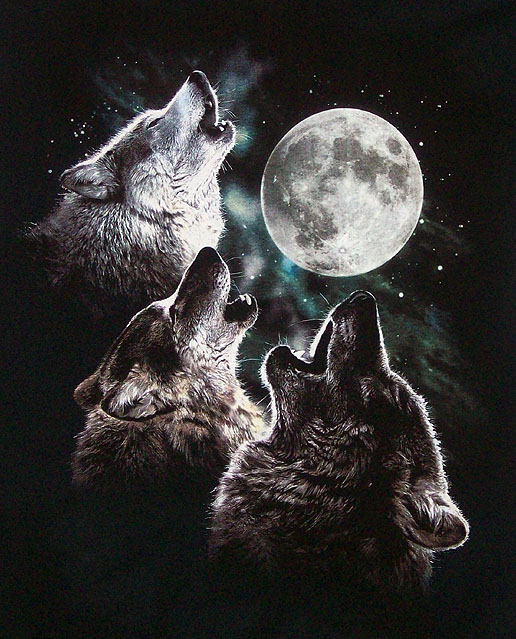
modern depictions of wolf art seem to be more of an attempt to capture their
natural beauty. Many paintings portray them in a natural setting, often howling
at the moon. One example of this is the infamous “Three Wolf Moon” picture.
Literature and Folklore
The
most common depiction of wolves in folklore seems to be the trope of the big
bad wolf. Aesop’s Fables, and Grimm’s Fairy Tales are two sets of works that
make heavy use of this character. There are many pieces of folklore that
portray wolves in a negative light, "The Wolf and the Lamb", "The Wolf and the
Seven Young Kids", "Three Little Pigs", and possibly the most famous "Little Red
Riding Hood". The classic story tells the tale of a young girl traveling through
the woods on the way to her grandmother’s house. On her way she meets a wolf
who she naïvely tells where she is going. The wolf makes it to her
grandmother’s house first and eats her. When little red riding hood arrives,
she is fooled by the wolf disguising himself
as her grandmother. By the time she realizes it is the wolf, he swallows
her whole. Luckily a hunter arrives and cuts the wolf in half, freeing Red
Riding Hood and her grandmother and killing the wolf.

A major
message of this story seems to be to highlight the danger of the woods. And
what better way to show danger than through the use of a wolf? Wolves in this
culture were viewed as dangerous and sneaky, often stealing livestock from
human farms. Although many classical tales tell stories about the big bad wolf,
little red riding hood is perhaps the most well known. Also unlike many other
stories such as Three Little Pigs and The Wolf and the Lamb, the story of
Little Red Riding Hood tells the story of
a human being victimized by a wolf. This allows children to feel a
stronger connection with her as a character and serves as more of a cautionary
tale to them than one that involves pigs or goats being eaten. The fear of
wolves contributes to the creation of this fairy tale, and in exchange it
itself breeds more fear.
Film
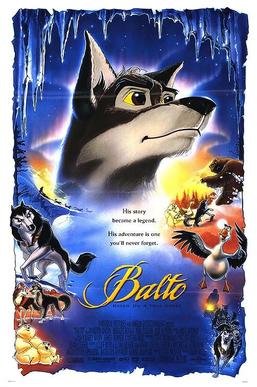 "Balto" is
an animated movie from 1995 that depicts the semi-historical tale of Balto, a
wolfdog in Nome, Alaska. In the film, many children in Nome contract
diphtheria, and poor weather conditions prevent delivery of medicine by
anything other than train, the nearest station for which is in Nenana. After
the original sled dog team sent to retrieve the medicine does not return, Balto
sets out to find them. He manages to find the team and using his keen wolf
senses, manages to guide them back to Nome in time.
"Balto" is
an animated movie from 1995 that depicts the semi-historical tale of Balto, a
wolfdog in Nome, Alaska. In the film, many children in Nome contract
diphtheria, and poor weather conditions prevent delivery of medicine by
anything other than train, the nearest station for which is in Nenana. After
the original sled dog team sent to retrieve the medicine does not return, Balto
sets out to find them. He manages to find the team and using his keen wolf
senses, manages to guide them back to Nome in time. "The Grey" is a 2011 film starring Liam Neeson that tells the story of a group of oilmen
stranded in Alaska after their plane crashes. They proceed to spend the rest of
the movie trying to make their way to safety as they are being hunted by a pack
of gray wolves. The wolves kill off the team members one by one until eventually
Liam Neeson’s character is the last one remaining. He find his way into the
wolves’ den and ends up fighting the alpha wolf. The ending is left ambiguous
as to whether or not Neeson dies fighting the wolf.
"The Grey" is a 2011 film starring Liam Neeson that tells the story of a group of oilmen
stranded in Alaska after their plane crashes. They proceed to spend the rest of
the movie trying to make their way to safety as they are being hunted by a pack
of gray wolves. The wolves kill off the team members one by one until eventually
Liam Neeson’s character is the last one remaining. He find his way into the
wolves’ den and ends up fighting the alpha wolf. The ending is left ambiguous
as to whether or not Neeson dies fighting the wolf.  These
movies show a very different attitude about wolves. And this is likely due to
their target audiences. Balto is aimed at children. Its story is more intended
to teach kids a lesson about how to (or not to) treat others who are different.
The fact that Balto is half-wolf is still important as the humans fear him because they perceive
him as dangerous. This gives the movie a secondary message that wolves are not
inherently dangerous, but instead are misunderstood. The movie also makes use
of a full wolf (albeit a possible spirit wolf) that comes to Balto in his time
of need to help him get back to safety.
These
movies show a very different attitude about wolves. And this is likely due to
their target audiences. Balto is aimed at children. Its story is more intended
to teach kids a lesson about how to (or not to) treat others who are different.
The fact that Balto is half-wolf is still important as the humans fear him because they perceive
him as dangerous. This gives the movie a secondary message that wolves are not
inherently dangerous, but instead are misunderstood. The movie also makes use
of a full wolf (albeit a possible spirit wolf) that comes to Balto in his time
of need to help him get back to safety.
Meanwhile, "The Grey" is aimed at adults and makes wolves out to be dangerous killers. The
wolves in the movie have seemingly no reason to hunt and track the characters.
The only reason given comes after the team kills a lower ranking wolf
supposedly sent by the alpha male to test them. One of the squad members cuts
off its head and throws it back at the pack. The others think this is a bad
idea and say that wolves are the only other creatures known to take revenge.
Balto
chose to tell the story of a wolfdog although the original dog the story was
based on was a Siberian Husky. This choice may have been purely to add a
subplot about racial discrimination to add to the story. "The Grey" on the other
hand seems to have chosen wolves purely because they can be made frightening.
The same story could have been told with bears or some other predator. Wolves
were likely chosen because of their pack hunting behavior which makes it easier
to have them out smart or out maneuver the human characters.
Mythology

Fenrir also has two sons. Sköll chases the horses that pull the chariot containing the sun, and Hati, who chases the moon. These two keep the cycle of night and day until Ragnarok when they will finally succeed in catching the sun and moon.
 |
| Another important part of Fenrir’s myth is his role in the apocalypse, Ragnarok when he will fight and kill Odin, father of the gods. |
 Both of
these legends give the picture of wolves as fearsome hunters. There are even
stories of wolves being ridden by witches and giantesses, dangerous humanoids
whose association with the animals may have been meant to make them seem more
formidable.
Both of
these legends give the picture of wolves as fearsome hunters. There are even
stories of wolves being ridden by witches and giantesses, dangerous humanoids
whose association with the animals may have been meant to make them seem more
formidable.
Norse
portrayals of wolves are not all negative however. Odin himself is said to have
two faithful wolf pets Geri and Freki who are described as being of good omen.
Odin treats these wolves generously, even feeding them food from his table as
he himself only requires wine as food and drink.
These myths about wolves seem to intend caution. Although the wolves are seen as fearsome and, in the case of Fenrir, dangerous, Odin’s keeping of them as pets still brings them some amount of respect. The Nords were a people who valued strength. Many of their myths about their gods tell stories about contests of strength and battles. It is for these reasons that they seem to respect wolves for the formidability and treat them with caution rather than fear.
Contoversy
Although
hunting of wolves was a very common practice thousands of years ago, today it
has become a much more controversial subject. One side argues that it is
essential management of wolf numbers, whereas the other side argues that it is
harmful to the environment.
 Not all is well with these programs however. There are
some scientists that argue that the artificial inflation of moose and caribou
populations could lead to habitat destruction and ultimately a decline in those
populations.
Not all is well with these programs however. There are
some scientists that argue that the artificial inflation of moose and caribou
populations could lead to habitat destruction and ultimately a decline in those
populations. A larger issue arose in 2007, when Gov. Palin approved
the shooting of wolves and bears while flying, claiming that it was for
protection of property. This drew fire from members of Congress, who drafted
legislation entitled the Protect America’s Wildlife (PAW) Act, which intended
to close the loophole allowing aerial management of wildlife. This bill was never
enacted.
A larger issue arose in 2007, when Gov. Palin approved
the shooting of wolves and bears while flying, claiming that it was for
protection of property. This drew fire from members of Congress, who drafted
legislation entitled the Protect America’s Wildlife (PAW) Act, which intended
to close the loophole allowing aerial management of wildlife. This bill was never
enacted.
A major argument against hunting wolves is that they work
in tandem with wildlife managers. They cull the numbers of game species and
kill off unhealthy individuals, raising the overall health of the herd. Without
wolves, it is argued that prey numbers would grow to unsustainable levels and
severe damage would be done to the ecosystem.
Supporters of wolf hunting claim that wolf populations
have a negative effect on game herds and blame them for dramatic drops in prey
populations. One example of this is the drop of southern Alaskan caribou
populations from 10,000 in 1983 to about 600 in 2008.
I believe that the management of wolves is much like the management
of any other wild life species. We must first analyze the trends of the
existing populations and determine human effects on them. In the event that
hunting has to occur to help recover another species numbers, we must take the
time to accurately determine a safe number that can be culled without upsetting
the balance even further. I do not agree with killing wolves to artificially
increase the numbers of species like caribou and moose so that those species
can be hunted. I believe that hunting in and of itself should only be used for
management purposes and so artificially inflating a species’ numbers, just so
you can cull them again seems inhumane and cruel.
Resources
Griffin, Emma (2007). Blood Sport: Hunting in Britain Since
1066. p. 296. ISBN 0300116284.
Orchard, Andy (1997). Dictionary of Norse Myth and Legend. Cassell. ISBN
0-304-34520-2
Guerber, Hélène Adeline (1992) [1909]. "Odin's
Personal Appearance, Greek and Northern Mythologies". Myths of the Norsemen: from
the eddas and the sagas (Dover ed.). Mineola, N.Y.: Dover Publications.
pp. 17, 347. ISBN 0-486-27348-2. "At his feet crouched two wolves or hunting hounds, Geri
and Freki, animals therefore sacred to him, and of good omen if met by the way.
Odin always fed these wolves with his own hands from meat set before him."
"Overview
of Relationships Between Bears, Wolves, and Moose in Alaska".
Wc.adfg.state.ak.us.
